Vikings (2013-21) is a historical drama TV series, broadly based on the life of legendary leader Ragnar Lothbrok. While I’m no expert on this particular period, the series plays pretty loose with history. E.g. the series began in season 1 with a story based on the Lindisfarne raid of 793, but one major plot arc of season 3 is based on the Viking siege of Paris in 845, and characters have only aged a few years.
For this blog’s purposes, we are concerned with a subplot of the siege of Paris arc. The leader of Paris’ defense against the Vikings is Count Odo (played by Owen Roe, loosely based on Odo of France), who chafes under the rule of Emperor Charles. Odo’s lieutenant Roland (Huw Parmenter) sends his sister, Therese (Karen Hassan), to seduce the count. So far, so typical for this kind of show.
I have not seen Wuthering Heights (2026), nor do I have more than a passing familiarity with the story. The fetishistic and sadomasochistic elements of the new adaptation have sparked some discussion. I leave it to my friend and colleague, TammyJo Eckhart, to explore this topic. The following is reposted from her Patreon with her permission.
Maybe you’ve seen the online reviews and news articles about the “kinky” nature of this film. I’m gonna to mention that, but this is really a jumping off place for discussing my two favorite topics – history and consent.
There will be spoilers for the 2026 movie, but I will try to keep them minimum and based on “kink,” consent, and history.
I had some high sexy hopes for this movie before I watched it on June 23, 2026, because of all of the complaints about how it introduced kink into the story that overwhelmed everything else. I’m not sure what film those reviewers and commenters were discussing but that wasn’t the movie I saw.
I know that I have a high bar for kink given that my colleague, Peter, and I try to put out a new kinky movie discussion video every couple of months. I also know that as someone who lives this life 24/7/365 days a year, my definition of what is and is not kinky is probably not reflective of the mainstream culture. To understand why I don’t see this as a BDSM work, I need to explain some historical context.
The novel and this movie version should be set between 1771 and 1802 in the Yorkshire moors of England. This is not a time period when individual rights are NOT respected for almost anyone, king and landed nobles included. Catherine Earnshaw’s family may be nobles, but most of their wealth is land and the people connected to it. Her father is a drunken a-hole who has gambled which makes them indebted to creditors. You see that in the mess of their large estate as well as the sparse furnishings. When Earnshaw returns one night with a boy in tow, he may not have bought him with money, but everyone there knows that the boy now belongs to the estate and by extension to the Earnshaw family whose daughter, Catherine, renames him Heathcliff (after her dead brother, by the way).
Heathcliff chooses one person in particular to give his loyalty to because of her treatment of him, Catherine. He gets between her and her family, he accompanies her out on the moors, he tries to protect her from his sexual desires as well as seeing displays of others engaged in sex. There relationship isn’t based on a negotiated consent because that would make no sense given that time between someone of such two different social and legal statuses.
There is also strict legal and social differences between men and women during that time. If both people are of the same class, then the men’s rights would be greater than the woman’s. That doesn’t mean that they can’t care about each other. We see that in the barn scene between stablehand, Joseph, and maid, Zillah. Yes, they do have sex while she is wearing a bridle, but from the language and the actions, the maid is in charge and the stablehand cares about her safety. First, he hold up a whip but she shakes her head. When he holds up the bridle she smiles broadly and they place it on it. At this point Heathcliff covers Catherine’s eyes and mouth to keep her from revealing where she (and he) are but also I think in an attempt to protect a lady (which she is) from seeing something so base as intercourse. We still hear what is said which is that Zillah wants it all harder and Joseph agrees but also continuous praises her while doing so and then afterwards. It isn’t simply sex, there is a kink element to it, but I think of the two servants, the maid is in charge while the hand is topping.
Another kink element in the movie is the way that we see Heathcliff treat Isabella once they have a civil marriage ceremony to help him get back at Catherine for her cutting short their affair years after she’s been married. Heathcliff may not be a lord, that is unclear in the movie, but he has money (somehow) and buys the Earnshaw estate. He doesn’t do much with it because he is used to it being rundown and poorly kept. Taking Isabella to that estate he hopes will enrage Catherine enough that she’d demand he attone in some fashion. Isabelle is his partner in this, though she seems fooled a bit into thinking she might keep him for her own. That is difficult to say because once she is removed from the Earnshaw estate, she disappears from the movie.
The scenes of Isabella and Heathcliff get the most attention in the reviews that focus on the kink. I want to call attention to a couple of factors I wasn’t expecting but where clearly there in the film. First, when Heathcliff comes into her room and proposes this scheme to her, he is straight forward about how he will treat her and asks if she wants him to stop. The only word we hear from her after he lays out several times how poorly he will behave and asks for her to tell him to stop, is “No” because she wants to try this. Why? I have no clue. Up until this point, Isabella has acted like a spoiled princesses whose guardian Edger married Catherine. In part, I suspect that marriage was one to please Isabella more than Edger given how free his ward is to treat Cathering of a sort of doll for her to dress up and demand attention from.
The abusive treatment that we see Heathcliff give to Isabella is through the lens of letters that she writes upon his pleas to Catherine. Plead he does because Isabella can read and write and he cannot. He even gets on his knees during these letter writing snippets and she grabs him by the front of his shirt demanding that he “treat her nice” if she does this. The highlight of the “abuse” comes when Catherine’s lady-in-waiting, Nelly, comes to visit. She finds Isabella chained up like a dog and acting like a dog. However, note that Isabella looks only slightly disheveled as though it was done on purpose. She even winks at Nelly at the end of that scene and then we see Heathcliff kneeling again while a letter is written.
How much of what Heathcliff and Isabella do is reflected in these performances we cannot know, because it isn’t about them, it is about Heathcliff wanting Catherine to come back to him.
Nelly has been intercepting the letters as well as playing Edgar and Catherine against each other during this time. Nelly’s family probably had fallen on hard times forcing her to become a lady-in-waiting to Catherine since childhood. When Catherine discovers that Nelly knew that Heathcliff heard only part of the discussion about the marriage with Edgar, she is furious. Nelly’s choices are entirely based on her position; whatever affects Catherine affects her. She would probably end up on the street herself if she allows Catherine to fire her, so she She isn’t a good person for what she does, but these are the historical realities for her decisions.
Catherine really doesn’t an easy choice. She is pregnant with her husband. She is dependent on Edgar’s money and he on her noble family title. In the scenes of the years after the marriage when Heathcliff has been who-knows-where, Catherine has moments of joy and happiness, but also periods of boredom and longing for something more exciting. In a world where her husband had legal and social rights to harm her in a multitude of ways, his gentle and generous nature might be seen as ideal by many women and their families. Is she a masochist? I doubt it based on how we see Heathcliff and Edgar treat her. I think she wants passion and she wants to be able to tease her partner and feel some pushback from him.
Heathcliff has pledged himself and his love to her when they were children after he took a severe beating from her drunken father in her place. His love seemed more drawn from feeling grateful mixed with the ages they were as they discovered sexual feelings. He didn’t tell her more because of their social and legal positions in the beginning and then because he only hears part of her reasoning for accepting Edgar’s marriage proposal and is angry. How much consent did he have in his entire for what he experienced and later felt?
It is a beautifully shot film and very intense but not because of the “kink” in our 21st century BDSM meaning of that term.
If you’ve seen it, I’d love to hear what you thought about it.
Killing Me Softly is a 2002 erotic thriller directed by Chen Kaige and starring Heather Graham and Joseph Fiennes.
Alice (Graham) lives in London with her sweet but dull boyfriend. After a chance sexual encounter with a mysterious man (Fiennes), she tracks him down and learns he is Adam Tallis, a famous mountaineer who saved the lives of six people in an accident that killed many others. Alice leaves her boyfriend and starts a relationship with Adam.
Killing seems like an experiment in how many red flags a man can have and still be attractive. Adam is brooding, mercurial, controlling and haunted by the accident, in which the woman he loved died. When Alice is mugged on the street, Adam doesn’t just chase the assailant down, he brutally beats him, then immediately proposes marriage to Alice.
Red Shoe Diaries S01E03 “You Have the Right to Remain Silent”, Aired July 14, 1992 IMDB
Zalman King, a former actor who produced Nine and a Half Weeks and a few other softcore mainstream films, created the anthology series Red Shoe Diaries which became the flagship of 1990s direct-to-cable-TV softcore erotica, free from the constraints of both the MPAA and Broadcast Standards and Practices. The framing device is that Jake (pre-X-Files David Duchovny) is haunted by the suicide of his fiancée. He found her diary and learned she was having an affair with another man. He places ads in newspapers asking women to tell him their stories of desire. The confessional mode, as an inquiry into the “truth” of female sexuality, is built into the series’ premise.
Linda Evans is a damsel-in-distress in Beach Blanket Bingo (1965)
My most intriguing find in the Kinsey Archives was a 51-page mimeograph of a typewritten document from 1975, Bondage Fantasies in Popular Entertainment, attributed to “G. Allen Marburger.” It’s an idiosyncratic list of bondage scenes in mainstream film and television, possibly an unpublished magazine article, as there are references to kink-media company HOM (House of Milan).
Strangeland is a 1998 thriller/horror film written by and starring Dee Snider (of 80s glam metal band Twisted Sister) and directed by John Pieplow. Amazon
The Libertine, also know as La Matriarca, is a 1968 film directed by Pasquale Festa Campanile and starring Catherine Spaak. IMDB
A wealthy man, Franco, suddenly dies and leaves everything to his young, beautiful wife, Margherita (aka Mimi). She finds that he had been seeing a string of mistresses, and sets out on a journey of sexual exploration.
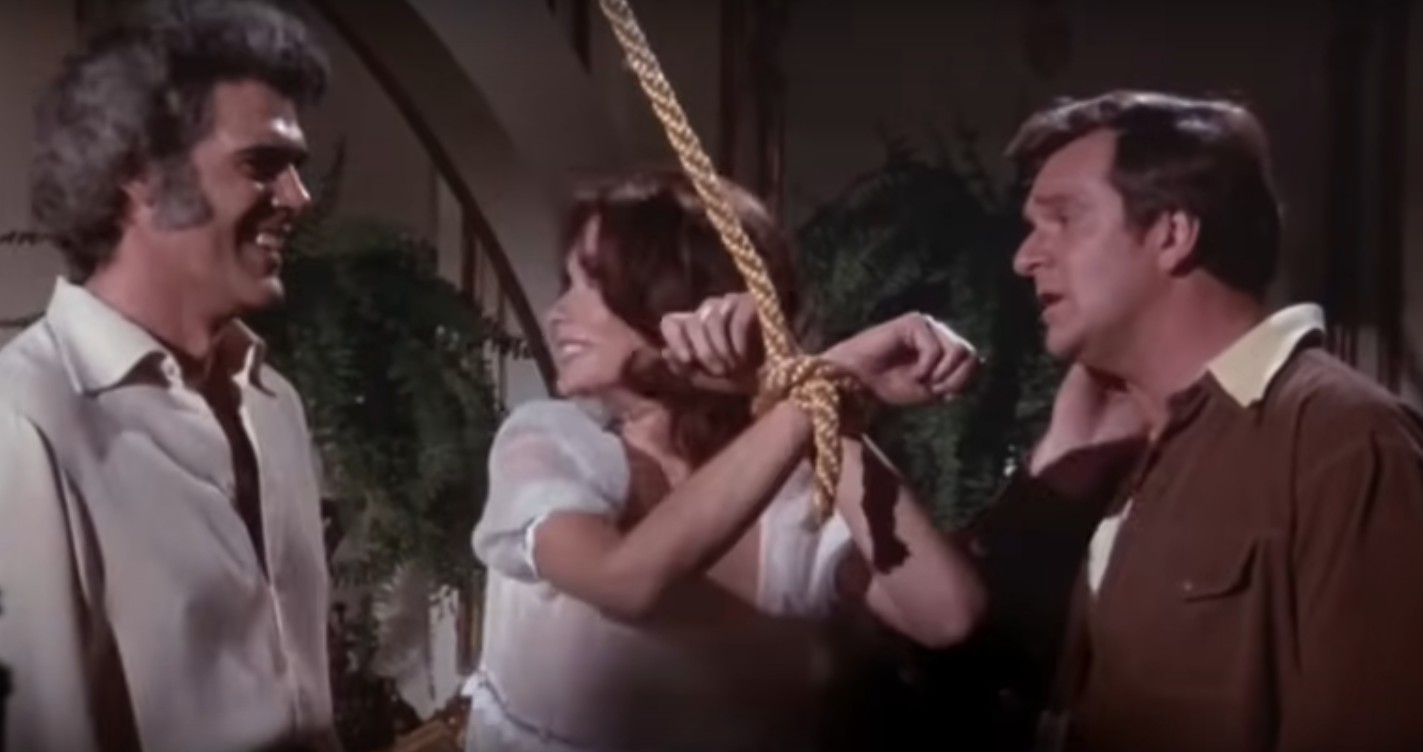
Police Woman S03E21 “Bondage”, aired March 1, 1977, dir. Arnold Laven, wri. Irv Pearlberg & Frank Telford
Police Woman was a 1974-1978 cop show that starred Angie Dickinson as Sgt. “Pepper” Anderson, set in Los Angeles. Episode “Bondage” involved Pepper infiltrating the porn industry.
The opening scene is set in an old-timey looking room, with a woman tied up by the wrists, standing. A maid (in a completely ahistorical uniform) comes in to help her “Countess”. (The background sound of a camera whirring betrays that this is a performance.) A man in period-ish wig comes in, dismisses the maid, and rips the back of the Countess’ nighgown. (No actual nudity, of course.)
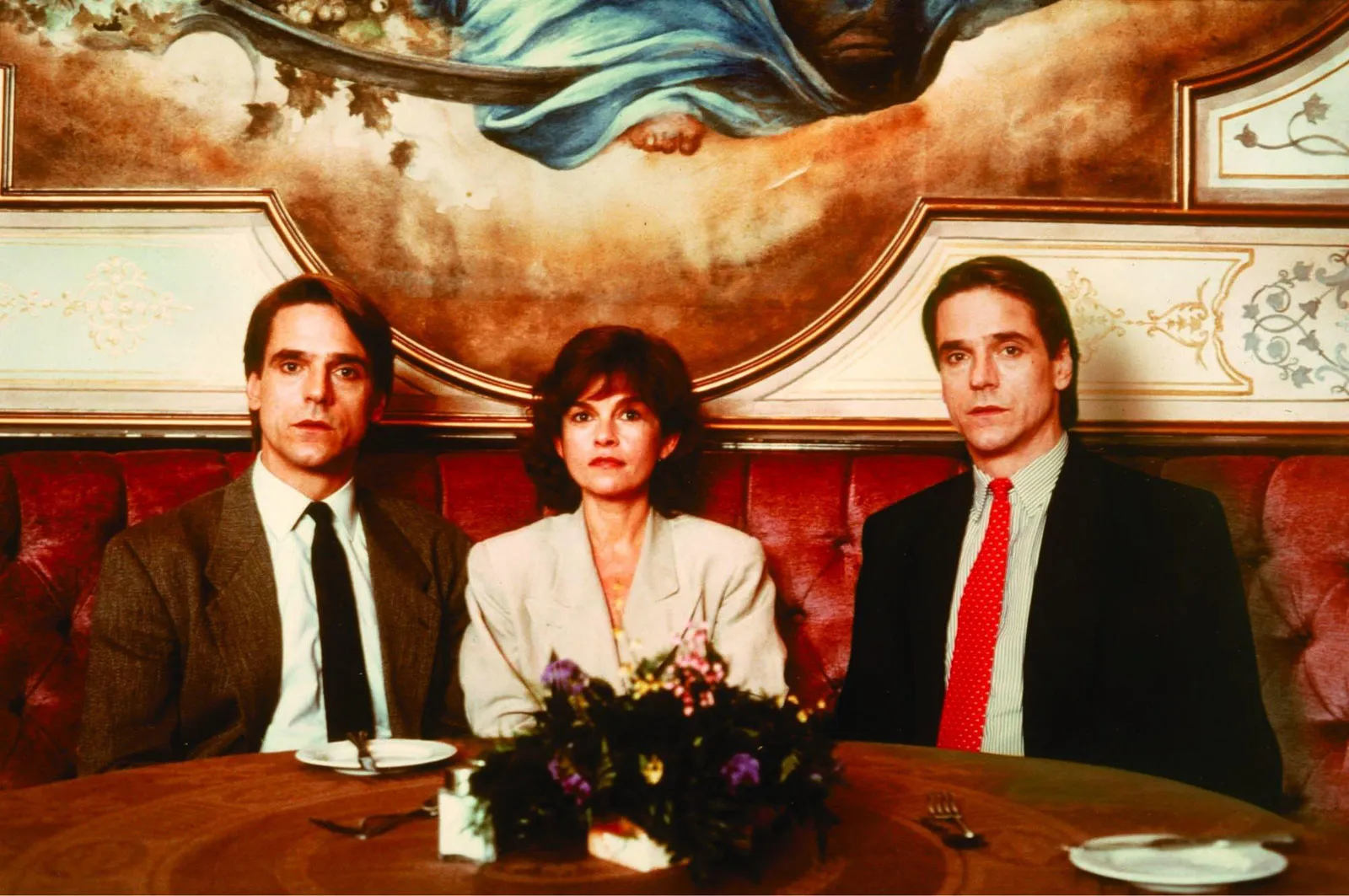
Dead Ringers (1988), directed by David Cronenberg, starring Jeremy Irons and Genevieve Bujold. Amazon
The film is based on a true story of a pair of identical twin gynecologists who died in a murder-suicide. Irons plays both Doctors Beverly and Elliot Mantle, and Bujold plays actress Claire Niveau, who catalyzes their disintegration.
In the story, Beverly does most of the work that makes them wealthy and famous in their field, while Elliot does the glad-handing and schmoozing. Beverly is fascinated by the “trifurcated uterus” of Claire, a troubled actress searching for a cure for her infertility. As they have done before, the confident Elliot seduces Claire and then passes her on to the shy Beverly, who claims to be Elliot. However, Beverly develops deeper feelings for Claire, and that reveals a hairline fracture in the partnership of the Mantle twins.
Verfolgt, also released as Hounded or Punish Me, is a 2006 German drama directed by Angelina Maccarone. Amazon
As I’ve pointed out before, female dominants who aren’t sex workers are almost invisible in popular culture. Verfolgt is one of the rare examples of a dominant woman who is not in part motivated by money. Elsa, a youth probation officer, has an obsessive, sadomasochistic affair with Jan, a young offender fresh out of juvenile detention.
Elsa Siefert (Maren Kroymann) is in her 50s, and looks like it. You can see her wrinkles and soft belly. She does wear a black leather coat and shoes, which hint at her interests. Early in the film, her daughter moves away, and her relationship with her husband, Raimar, has begun to sour. She resents his past infidelity. The loss of her roles as wife and mother has left her adrift.