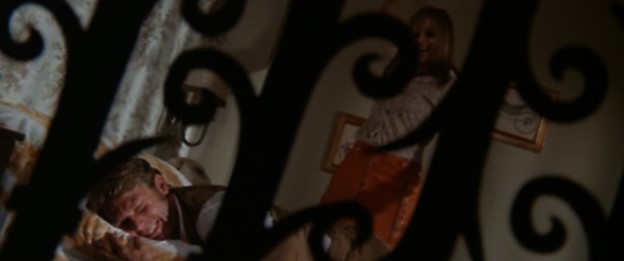
Femina Ridens (aka The Laughing Woman, The Frightened Woman) is a 1969 Italian psychological drama, starring Philippe Leroy and Dagmar Lassander, and directed by Piero Schivazappa. IMDB
Dr. Sayer kidnaps Maria, a young woman, and locks her in his prison-like apartment, saying he will psychologically torture her into loving him, then kill her. Maria, however, is much more than she appears.
The Feeling That the Time for Doing Something Has Passed is a 2023 comedy-drama, directed and written by Joanna Arnow and starring Arnow, Scott Cohen and Babak Tafti. IMDB
Ann, a thirty-something woman in New York City, seeks relief from the difficulties with her job and family through submission to various men.
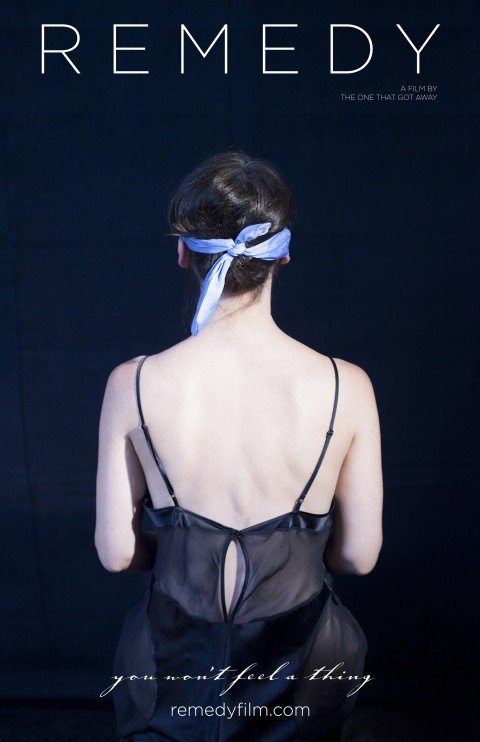
Remedy is a 2013 drama directed by Cheyenne Picardo and written by Picardo et al.
A young woman known only by her nomme de domme, Remedy (Kira Davies), explores the world of professional domination and submission. She has some experience with BDSM at a night club, where she met a woman named Astrid, who hooked her up with a dungeon in NYC. Her motivation isn’t clear, whether it’s money or something else. (She has an unseen boyfriend and works as a children’s tutor.)
Secretary (2002) has taken up a disproportionate amount of time in researching and writing The Celluloid Dungeon. I already knew there were a lot of differences between Mary Gaitskill’s original short story and the finished film directed by Steven Shainberg, but I’ve since learned there were significant differences between Erin Cressida Wilson’s script and the finished product. (See Ariel Schudson’s “Secretary and Adaptation: the Telephone theory”) Thanks to inter-library loan, I’ve borrowed a copy of the script book, which also includes essays by Wilson and others.
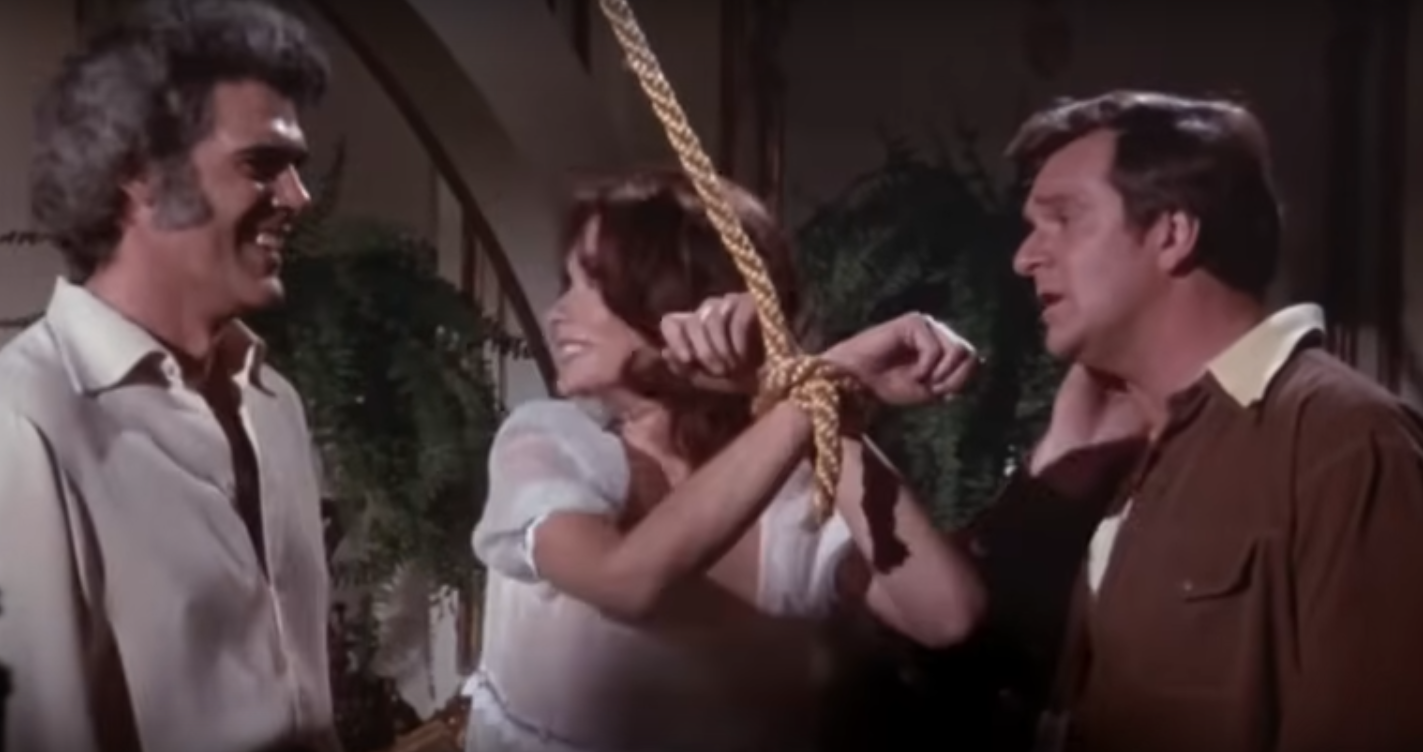
Police Woman S03E21 “Bondage”, aired March 1, 1977, dir. Arnold Laven, wri. Irv Pearlberg & Frank Telford
Police Woman was a 1974-1978 cop show that starred Angie Dickinson as Sgt. “Pepper” Anderson, set in Los Angeles. Episode “Bondage” involved Pepper infiltrating the porn industry.
The opening scene is set in an old-timey looking room, with a woman tied up by the wrists, standing. A maid (in a completely ahistorical uniform) comes in to help her “Countess”. (The background sound of a camera whirring betrays that this is a performance.) A man in period-ish wig comes in, dismisses the maid, and rips the back of the Countess’ nighgown. (No actual nudity, of course.)
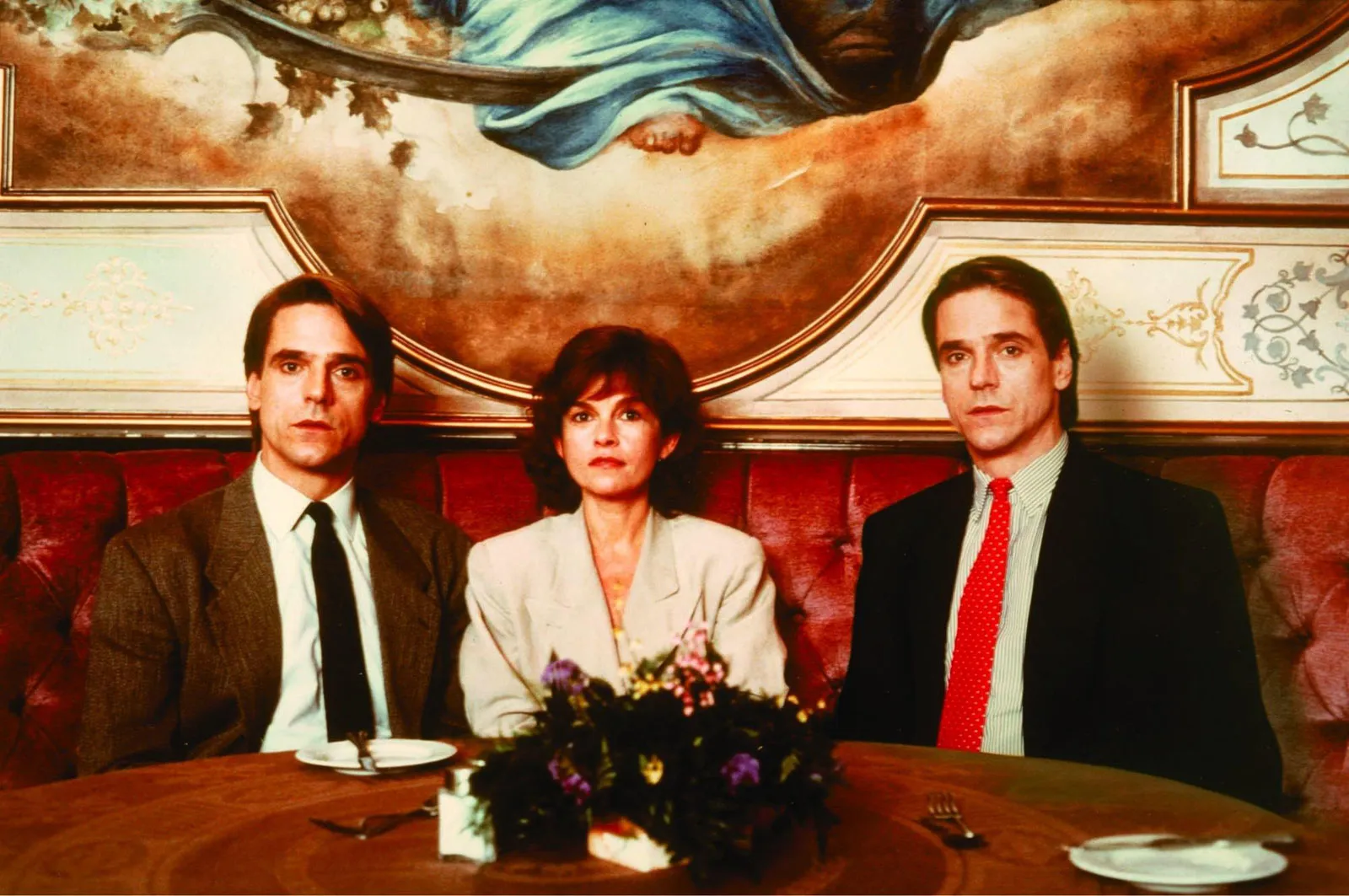
Dead Ringers (1988), directed by David Cronenberg, starring Jeremy Irons and Genevieve Bujold.
The film is based on a true story of a pair of identical twin gynecologists who died in a murder-suicide. Irons plays both Doctors Beverly and Elliot Mantle, and Bujold plays actress Claire Niveau, who catalyzes their disintegration.
In the story, Beverly does most of the work that makes them wealthy and famous in their field, while Elliot does the glad-handing and schmoozing. Beverly is fascinated by the “trifurcated uterus” of Claire, a troubled actress searching for a cure for her infertility. As they have done before, the confident Elliot seduces Claire and then passes her on to the shy Beverly, who claims to be Elliot. However, Beverly develops deeper feelings for Claire, and that reveals a hairline fracture in the partnership of the Mantle twins.
I Love a Man in Uniform (also released as A Man in Uniform) is a 1993 Canadian psychological drama. IMDB
Henry Adler, a bank clerk and would-be actor, witnesses a police officer be shot. He seems excited by this.
Henry auditions for a secondary role, Officer Flanagan, on a TV cop show, Crimewave. He shows an aggressive and domineering side as he pushes around a female production assistant.
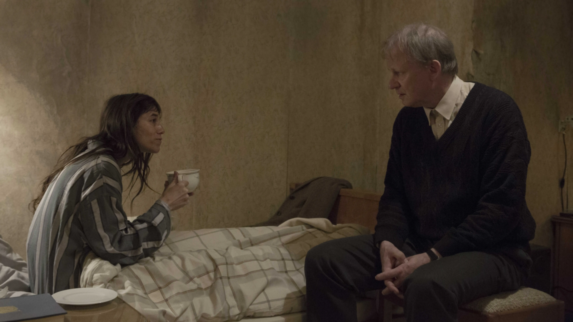
Nymphomaniac Volume 2 is the second part of notorious director Lars von Trier’s 2013 film about a woman with sexual compulsion.
The framing story is that Seligman, an elderly academic, finds a beaten women in an alley near his apartment, and takes her home. She says her name is Joe, and when Seligman asks her how she ended up in his alley, she says she would have to tell him her entire life story. Over one night, Joe tells Seligman her biography in search of sexual pleasure, with frequent asides from both of them on topics ranging from techniques of fly fishing to the history of religious art. This dialog also acts as a kind of trial, with Joe prosecuting herself as a bad person who deserved her mistreatment, and Seligman defending her decisions and her worth as a person.
O Fantasma is a 2000 Portuguese film directed by Joao Pedro Rodrigues. It concerns Sergio, a young man working as a night time garbage collector in Lisbon, and his sexual development.
Sergio is, to say the least, alienated. He inhabits a largely empty night-time world. While he flirts with a female co-worker, Fatima, his main sexual connections with others are wordless, anonymous sexual encounters with men. Not only does he connect to the company’s mascot dog, he’s animal-like himself. He rarely speaks, and often sniffs and licks people and things. Sergio just doesn’t have the social vocabulary to express his sexual identity. He operates more on intuition.
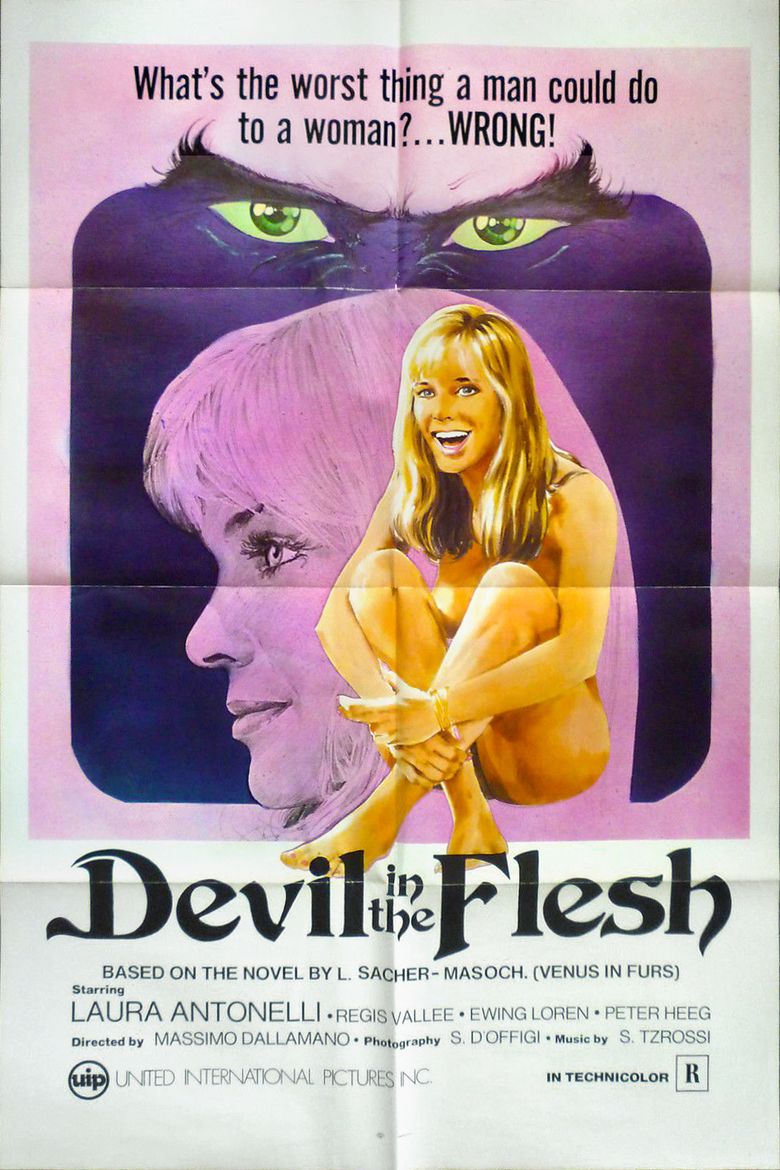
This is the second film named Venus in Furs released in 1969, also known as Devil in the Flesh or La malizide di Venere. It’s a semi-faithful adaptation of the original 1870 book, unlike some other films which have little to do with the original text. However, there are significant thematic differences.
The film skips the framing story of the book. The film opens in the present day at a retreat in the Swiss Alps, where Severin, a writer, is staying.
When young Wanda von Dunajew, a model, arrives, Severin is immediately taken with her from afar. He later spies on her through hidden peepholes (with the acknowledgement and encouragement of the resort’s female manager). She conveniently takes a shower at that moment, then admires herself in furs, then masturbates. The sequence is framed through the gaps in the wall.
This prompts Severin to flashback to his childhood, when he spies on the maid and the chauffeur having a tryst.
Voyeurism and exhibitionism is a big part of the first half of this movie. Severin doesn’t just take scopophilic pleasure in watching Wanda, there has to be another person there, usually a man, who also gazes at her. Wanda actively flirts in some cases, courting the gaze. Later, Severin spies on her having an encounter with a younger man. This prompts another flashback to the maid and chauffeur. The maid spots young Severin and, while bare-breasted, slaps him, then cuddles him.
Severin and Wanda meet face to face, and make out in plain view of a number of people.
Severin: “In love, there are only masters and slaves. Those who dominate and those who are dominated.”
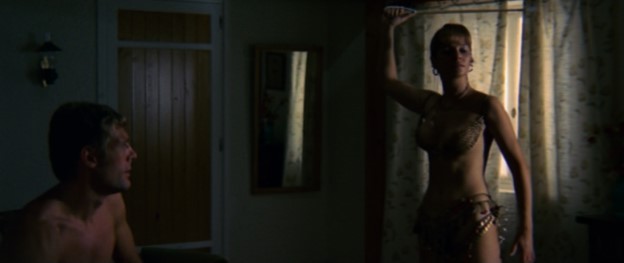
Wanda shows him a book of photographs of her, including one in an Orientalist chainmail outfit and a riding crop from when she was a stripteaser.
Wanda: “That was a Tartar Queen number. It was always a big success.”
She apparently has the full costume with her, including the crop, and does it for Severin. She swishes the crop around and accidentally (?) hits him in the face. He finds it pleasurable. She is apologetic. He tells her to whip her again, on his bare back.
After they dance at a club, she says she knew he was spying on her, and enjoyed performing for him. He tells her he wants her to make him suffer.
Severin talks about how the problem of love is monotony, and the woman should seek other pleasures. She tells him she feels drawn to breaking through limits with him.
Implication of cunnilingus, though no exposure.
Severin: “I’m very happy when others desire you.”
Wanda: “You really aren’t jealous?”
Severin: “No, as long as I’m part of the game.”
Wanda: “Then there’s only pleasure for you when I provoke other men while you watch.”
At a ranch, they watch a mare being nuzzled by a colt (young male horse) separated by a low wall. Then the colt is taken away and a big stallion is brought in to mount the mare, complete with visible horse penis. The ranch’s owner, an older man, is present and makes moves on Wanda.
Severin is turned on by this spectacle. Wanda looks at Severin suspiciously.
Next scene: Severin coaxes Wanda into seducing a young fisher, Andreas. He watches, of course. He follows them into the woods. Wanda and Andreas start having sex, then Andreas runs off and is replaced by Severin, followed by a sudden rainstorm.
They get married, and he gives her a beautiful fur coat. He also gives her a suicide note that gets her off the hook if something were to happen to him. “I want no limits to your cruelty.”
She feels tempted, and he wants to unleash her.
Roadside fellatio on him from her.
Severin and Wanda check into a house in Spain, near Costa Brava.
Severin: “I’d like to be treated just like an oriental slave.”
Severin takes the role of her chauffeur, complete with uniform and hat. Part of the game is them cuddling in public, playing at violating the class hierarchy. People stop and watch.
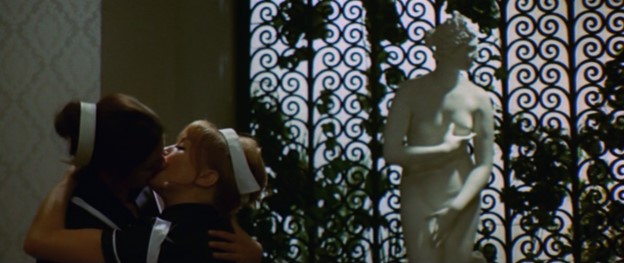
They also hire two white maids (instead of three African maids) who have their own sadomasochistic relationship. The younger of the two maids develops a crush on Severin, and exposes herself to him, meeting only with indifference. This maid returns to the older maid, who beats her for infidelity.
Severin urges Wanda to approach an artist, but complains when she spends an hour out of his sight with the artist. After the artist paints Wanda nude and holding a riding crop, Severin literally pushes her into the artist’s arms.
Fitting with the source text, there’s a lot of voyeurism and cuckoldry. Sacher-Masoch treated the cuckold scene as the ultimate expression of his fantasies, the worst thing a woman can do to him, to make him watch as she submits to another, stronger man. The problem is that in such a triad (“bull”-woman-cuckold/observer), there’s always the possibility of removing the woman from the scene like a redundant term in an equation. What’s left is one man dominating another.
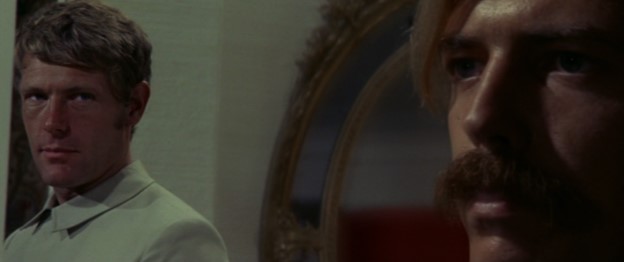
In the book, Severin was obsessed with pairing Wanda with the hypermasculine man known as “the Greek”. Here, it’s a big macho guy named Bruno, but Wanda is the one who picks him up off the road and invites him back to the house. Severin alternates between griping to Wanda about Bruno’s presence and mutely watching him as he dominates Wanda.
In the last of Severin’s fantasy sequences, Bruno has completely taken over the house. He has Severin wearing a mask like a dog’s muzzle, and “makes” him watch as he lords it over Wanda and the two maids.
After he drives away, Severin spots a group of sex workers by a gas station. One of them, Paulie, is also played by the same actress as Wanda, though in a blonde wig and with a mole on her cheek.
In a hotel room with Severin, Paulie comes off like a tough woman, but he suddenly turns on her and strangles her. The hotel staff come into the room and break it up, but Paulie tells them to leave him alone and that he was her friend. The staff leaves, confused but resigned.
She falls to her knees before him and says that his violence towards her was beautiful. She tells him she wants to be “your woman” and give him all the money she earns; in other words, have him be her pimp. She offers herself to him, and asks what he wants her to do.
The final scene is of Paulie happily whipping Severin. It suggests that what Severin really wants is a woman who will perform the role of the dominatrix, but remains below him in the privilege scale.
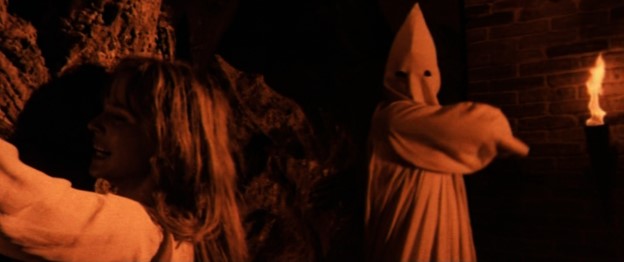
This version of Venus is difficult to watch. While it looks pretty, there’s an undercurrent of misogyny in its treatment of women. For a movie based on the ur text of male masochism, there are many scenes of women being slapped and beaten. They don’t even enjoy it in a masochistic way. They just cry and beg. In one of Severin’s fantasy sequences, he imagines her being dragged into a dungeon by hooded men, bound, stripped and beaten; one of the men removes his hood, revealing himself to be Severin.
This is in keeping in the source text, in which Severin, after his experience with Wanda, ruthlessly dominates women. (It also echoes Bitter Moon in which the male protagonist oscillates between sadism and masochism towards women, one requiring the other.)
Director Massimo Dallamano directed a number of Italian giallo films, and also worked as a cinematographer. His credits include classic spaghetti Westerns like A Fistful of Dollars (1964). Laura Antonelli (Wanda) had a long career as an actress, while Régis Vallée (Severin) only appeared in three other films. This appears to be the only screen credit of the screenwriter, Fabio Massimo.