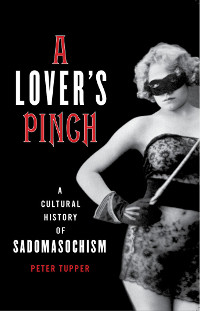
Nothing had prepared me. Some years back I had read The Story of O [sic], intrigued by the beginning, horrified after a few pages, repulsed long before the end. Sadomasochists in real life were black-leather freaks, amusing and silly in their ridiculous getups. If a friend, a peer, had told me she had herself tied to a table leg at home after a full day’s work at the office– well, it has never come up. God knows I would not have believed it. [Pg.54]
Nine and a Half Weeks by Ingeborg Day under the pseudonym Elizabeth McNeill, published 1978, is the semi-autobiographical account of her brief, obsessive, masochistic affair with an unnamed man. It was eventually adapted into the notorious Nine and a Half Weeks film in 1986, starring Kim Basinger and Mickey Rourke.
I had viewed and read about the film quite a bit before I read the short novel. It differs in several significant points. (For convenience, I will refer to the POV character as Elizabeth and her lover as John, though he is not named in the book.)
Linda Evans is a damsel-in-distress in Beach Blanket Bingo (1965)
My most intriguing find in the Kinsey Archives was a 51-page mimeograph of a typewritten document from 1975, Bondage Fantasies in Popular Entertainment, attributed to “G. Allen Marburger.” It’s an idiosyncratic list of bondage scenes in mainstream film and television, possibly an unpublished magazine article, as there are references to kink-media company HOM (House of Milan).
Salò (1975) was written and directed by Pier Pasolini as an adaptation of the notorious pornographic novel, The 120 days of Sodom, written by the Marquis de Sade while in the Bastille. It was part of the Naziploitation film boom in the mid-1970s. It was also Pasolini’s last film, released three weeks after his murder.
This movie will bore you, horrify you, or both.
Pasolini transplanted the story to Italy in the last days of WWII. Four fascists marry each other’s daughters, and form a covenant. They select a group of beautiful young women and handsome young men, some armed enforcers, and some elderly brothel madams, and seal themselves up in a chateau.
Strub, Whitney. 2011. Perversion for Profit : The Politics of Pornography and the Rise of the New Right. New York: Columbia University Press. Amazon
I’ve been reading Whitney Strub’s book, and despite its age, it is still very relevant in explaining the culture war over pornography in American politics. One of the things he details is though American history is littered with censorious firebrands like Anthony Comstock, those moral crusaders frequently stumbled over the problem that the majority of Americans don’t care very much about pornography as an issue. Men like Comstock and Charles Keating of Citizens for Decent Literature could mobilize a small, but vocal minority.
As Strub tells it, when the neoconservatives and the New Right rose to cultural power in the 1970s, they had to reconcile their belief in small government, free markets, and libertarianism with more culturally conservative allies, particularly evangelical Christians.
Thought it sought a socially conservative, generally religious voting base, the New Right was heavily corporate-sponsored, and such groups as the Committee for Survival of a Free Congress recognized the value of neocon thought in legitimizing their project of deregulating American markets even as they reregulated American morality.[Pg.190]
We’ve seen this strange-bedfellows alliance ever since, creating people who believe the Invisible Hand should rule everywhere except areas like pornography, abortion, and queer issues.
In 1979 the New Right organizer Paul Weyrich had come dangerously close to admitting the movement’s emphasis on social issues was a shallow commitment designed to garner evangelical votes while obscuring the substantive procorporate agenda of New Right politicians: “Yes, they’re emotional issues, but that’s better than talking about capital formation,” he said. Certainly the corporate benefactors of the New Right’s organizational superstructure valued profits over ideology; Coors, for instance, was headed by a reactionary zealot whose donations largely funded the important Heritage Foundation. But when the company recognized the consumer power of the gay market in 1979, it unhesitatingly ran ads in the gay paper the Advocate. [Pg.191-192]
More than 40 years later, we still see the same dynamic, even if the names have changed: trans people instead of gay people, puberty blockers instead of abortion, “cultural Marxism” instead of “the permissive society”. The 2023 brouhaha over trans streamer Dylan Mulvaney endorsing Bud Light suggests that the free-marketers sometimes back down when challenged by the cultural conservatives. Donald Trump himself embodies this contradictory political alliance: a man with multiple wives and a history of sexual indiscretions, who has been on the cover of Playboy magazine, can somehow be favored by the Christian right and even more reactionary forces. Grifters and quacks like Matt Walsh, Ben Shapiro, and Jordan Peterson constantly stoke culture wars over issues of sexuality and gender, anything to drown out considerations of economic policy from the discourse.
I’ve said it before, and I hope I’m wrong, but I still think it’s only a matter of time before BDSM takes the place of trans in this particular social-political complex.
“Sado Machismo” is an essay written by Edmund White and published in New Times, 8 January 1979, reprinted in the collection The Burning Library (Knopf, 1994)
White wrote this at a very different time: Not even ten years after Stonewall, before Cruising and definitely before HIV. The collection notes this essay was “… published during the height of Anita Bryant’s anti-homosexual campaign in Florida and in the midst of the Briggs Amendment campaign in California.” Gays and lesbians fighting for their rights to work as teachers were in the news, but a certain kind of “queer chic” was in the air too.
In the Realm of the Senses (aka Ai no Corrida, “Bullfight of Love”) is a 1976 Japanese-French film directed by Nagisa Oshima and starring Eiko Matsuda and Tatsuya Fuji. Amazon
The film is a fictionalized version of the true story of Sada Abe, who in 1936 Japan was arrested for the murder of her lover. She was found carrying his severed penis and testicles in her kimono. The film makes this a story of doomed lovers in a hostile world.
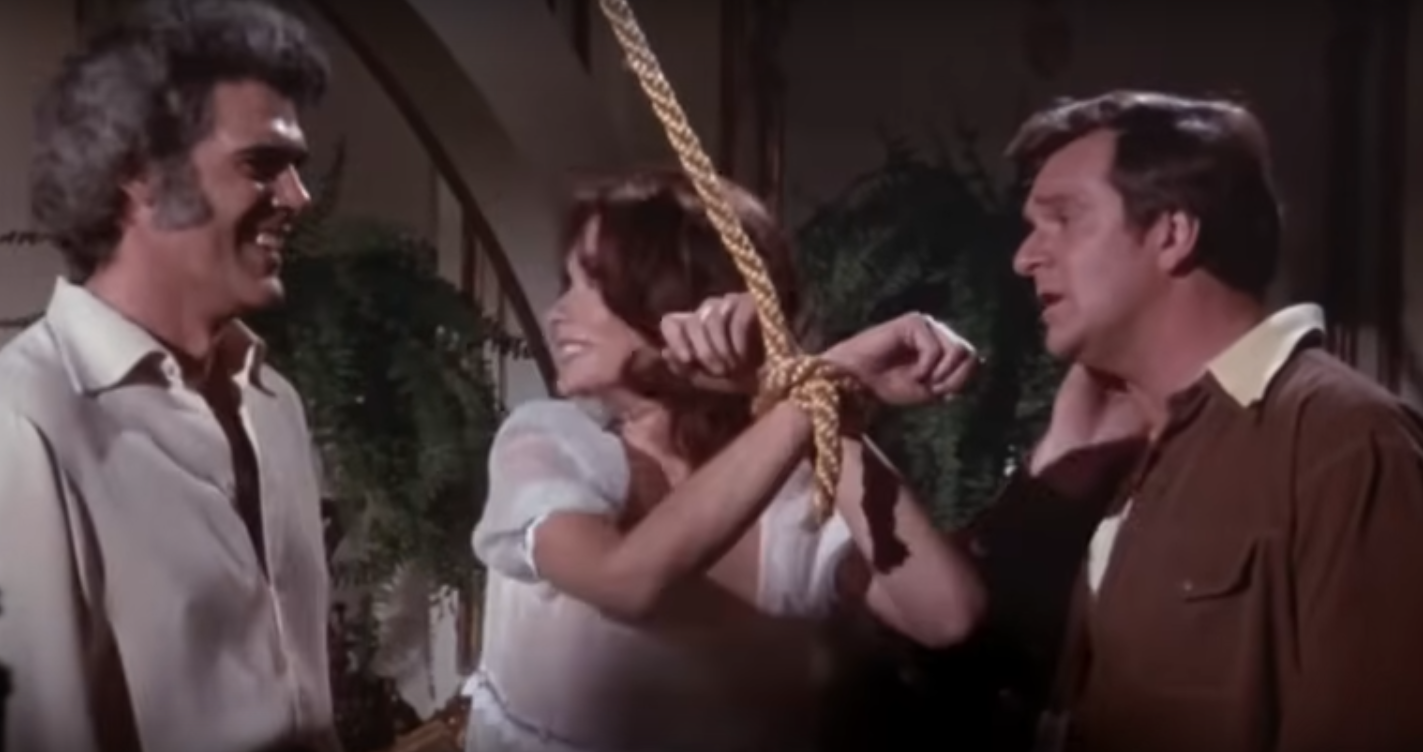
Police Woman S03E21 “Bondage”, aired March 1, 1977, dir. Arnold Laven, wri. Irv Pearlberg & Frank Telford
Police Woman was a 1974-1978 cop show that starred Angie Dickinson as Sgt. “Pepper” Anderson, set in Los Angeles. Episode “Bondage” involved Pepper infiltrating the porn industry.
The opening scene is set in an old-timey looking room, with a woman tied up by the wrists, standing. A maid (in a completely ahistorical uniform) comes in to help her “Countess”. (The background sound of a camera whirring betrays that this is a performance.) A man in period-ish wig comes in, dismisses the maid, and rips the back of the Countess’ nighgown. (No actual nudity, of course.)
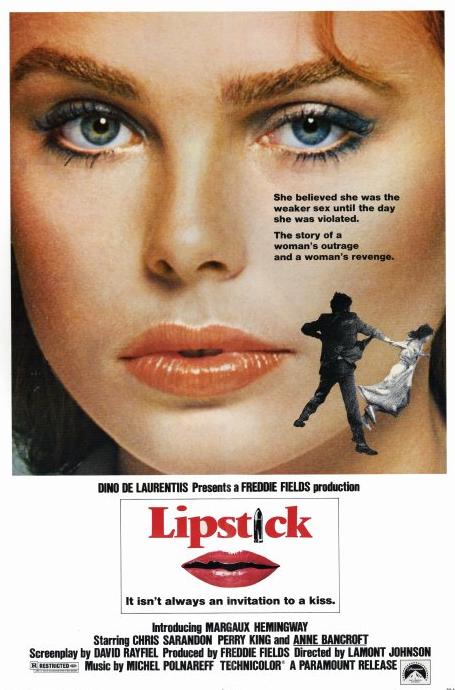
The first two acts are a straightforward drama. Chris McCormick, a famous model known for sexually provocative pictorials, agrees to meet with the music teacher, Gordon Stuart, of her teen sister, Kathy. Gordon, angered by Chris’ indifference to him and the glamour of her lifestyle, assaults and rapes her in her apartment, including tying her to her bed. Kathy briefly witnesses the end of this.
[Note: all English quotes are from the English dub.]
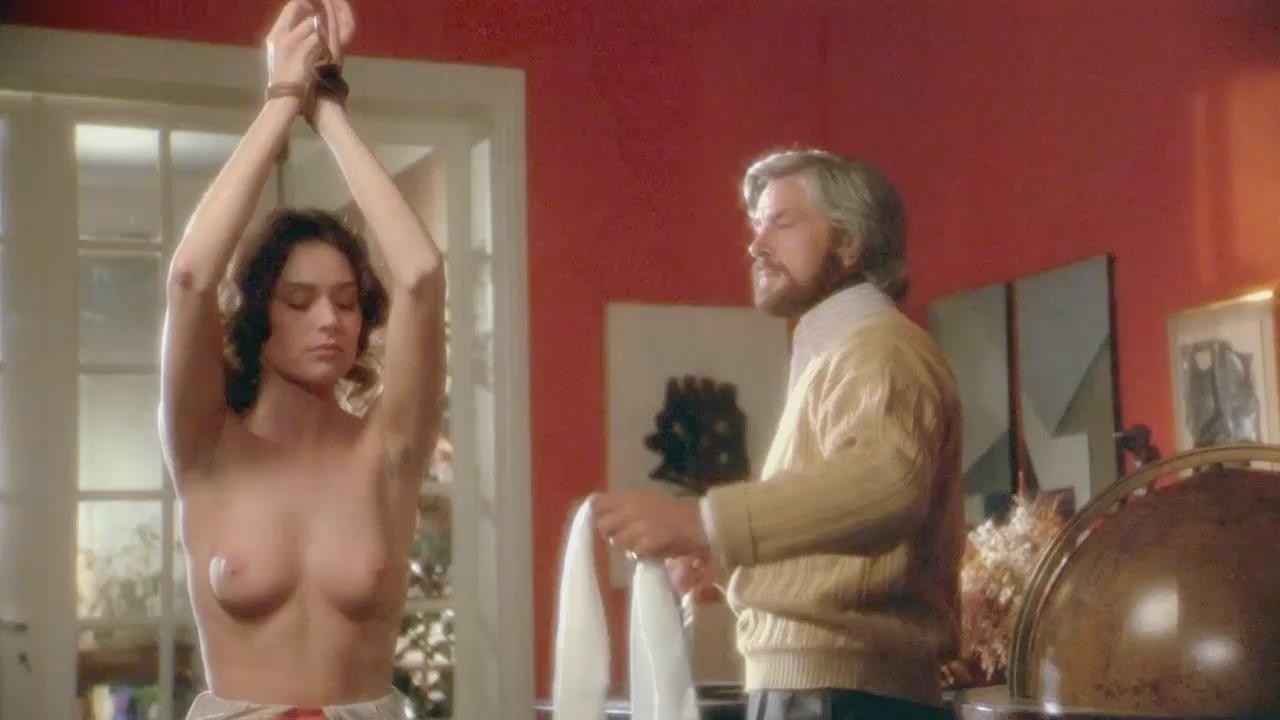
The relaxation of film censorship in the 1960s and 1970s, both in the US and abroad, created an interesting period in mainstream films were much more daring in terms of sexuality and violence, while some porn films had bigger budgets and higher production values to play in mainstream theatres and reach a larger audience. Naturally, someone would try to adapt arguably the most famous novel about BDSM to the big screen, Histoire d’O by “Pauline Reage” (aka Anne Desclos), published 1954.